From 18 November until 15 December 2021, four NIOZ colleagues are joining research expedition MSM104 "SIPA - Sinking Particles, their production, transfer and transformation" onboard Research Vessel Maria S. Merian, sailing from Emden (northern Germany) to the equatorial northeastern Atlantic Ocean and ending in Las Palmas de Gran Canaria (Spain).
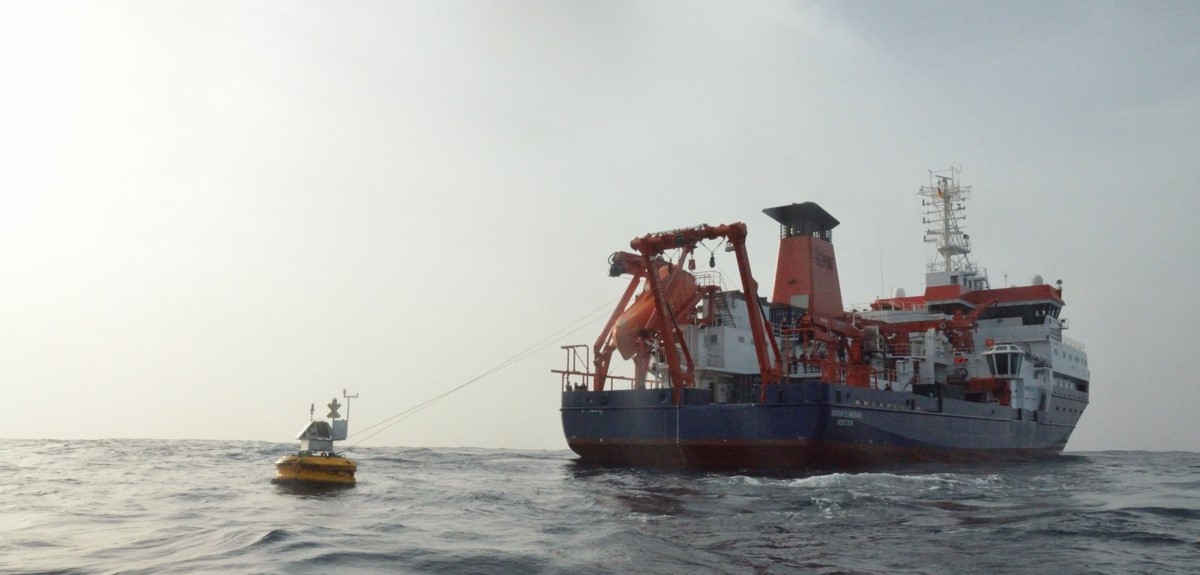
The aim of the expedition is to study sinking particles from sea surface towards the seafloor. The particular aim of the four NIOZ colleagues is to service dust-collecting buoys Carmen (off Cape Blanc, Mauritania) and Laura as well as high-resolution sediment-trap mooring M1 (both south of Cape Verde Islands) which have been collecting many particles, including Saharan dust, since we deployed them during RV Pelagia expedition 64PE482 in February 2021. In addition, we will be collecting dust with various instruments.
In the blog below you can follow our whereabouts and adventures at sea.
A parallel blog for this expedition is being kept on the MARUM website.
Regular updates below this part, latest update on top:
________________________________________
15 December – the SIPA dreamteam
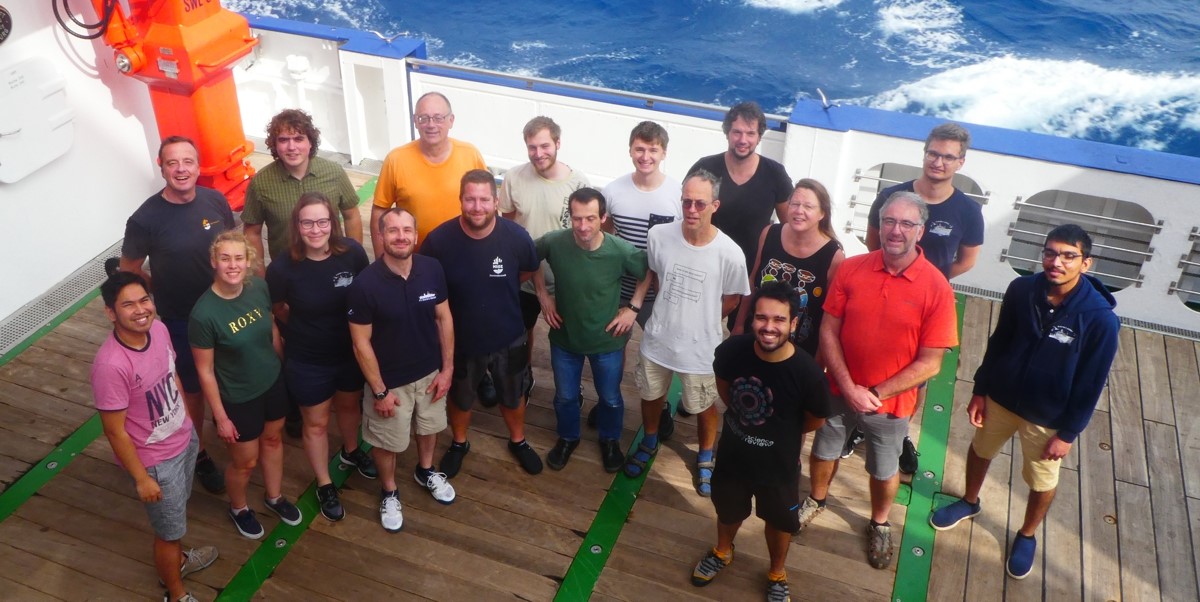
All good things come to an end, also this dusty research expedition. On behalf of the SIPA dreamteam (L2R: Eldo, Jan-Berend, Kristina, Daan, Melina, Michael, Götz, Jan Dirk, Joshua, Marco, Alek, Gerard, Hendrik, Eduardo, Karin, Bob, Leon, Aman) we thank Master Björn and his dreamteam of officers on the bridge, bosun Enno and his dreamteam on deck, Chief Engineer Sven and his dreamteam in the machine room and chef Matthias and his dreamteam in the pantry. We were spoiled with great food and comfort, a very pleasant working atmosphere and many present surprises from the ever-cheerful Sylvia. Many thanks and looking forward to the next time!
With that this blog is closed, many thanks for following and see at the next!
14 December – dust on satellite images
NASA offers daily satellite images on the Eosdis website with two overpasses every day; the Terra/MODIS overpass is in the morning and the Aqua/MODIS in the afternoon. These two images are also combined –to get rid of the black bars that are the result of the satellite’s orbit around the rotating earth— into a daily average but on the ‘raw’ images used for this animation, the Saharan dust plumes can be seen more clearly.
One can clearly see how during the period that we were in the area off Mauritania, dust plumes started to be blown across Cape Blanc onto the Atlantic Ocean on 28 November, and they hardly stopped since then; we have been truly lucky to witness so much dust in so many events!
The dust-collecting buoys offer the unique opportunity to calibrate these satellite images as they monitor and collect information not only on the meteorological conditions at sea but also on quantitative amounts of dust per m³ air. In addition, the new add-on to the buoys --the wet-dust collectors-- will give us information on how much Saharan dust is deposited on the ocean with rain. The synchronised collection of sediments by the submarine sediment traps will hopefully provide information about the marine environmental effects.
14 December – dust on deck
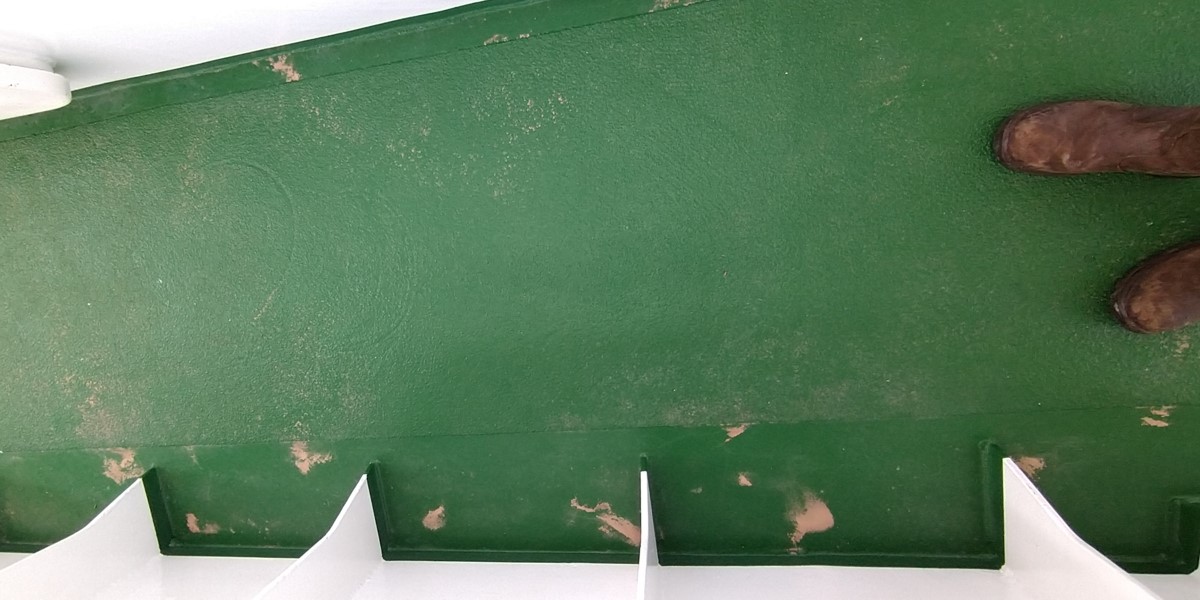
Now that we are approaching the Canary Islands from the south, it is clear that we are leaving the dusty region off Mauritania. Although the AB’s have cleaned most of the ship, here and there are some traces to be found of Saharan dust washed into little orange specks on the green deck.
13 December - washing machine
No dust without wind, but these winds also whip up waves! Although RV Maria S. Merian sails very smoothly, now and then she dips into the ocean, filling the portholes in the mess, making them look like a washing machine....
12 December – Dusty sunrise
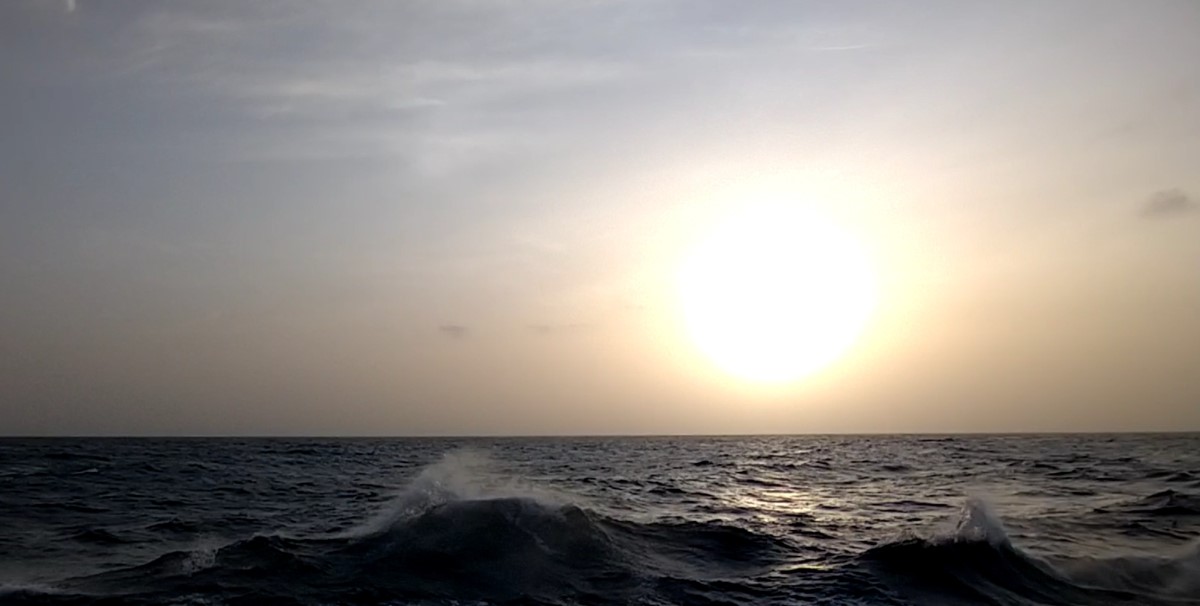
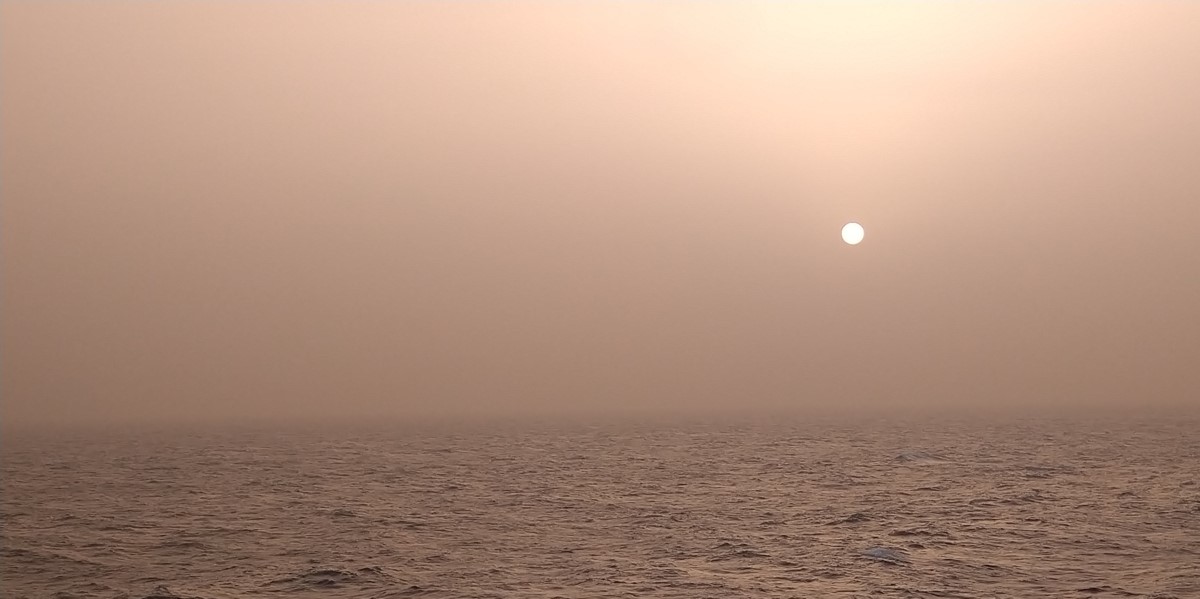
Once more we realise how lucky we are to do this work; enjoying another dusty sunrise at sea.
11 December – dusty buoy filters
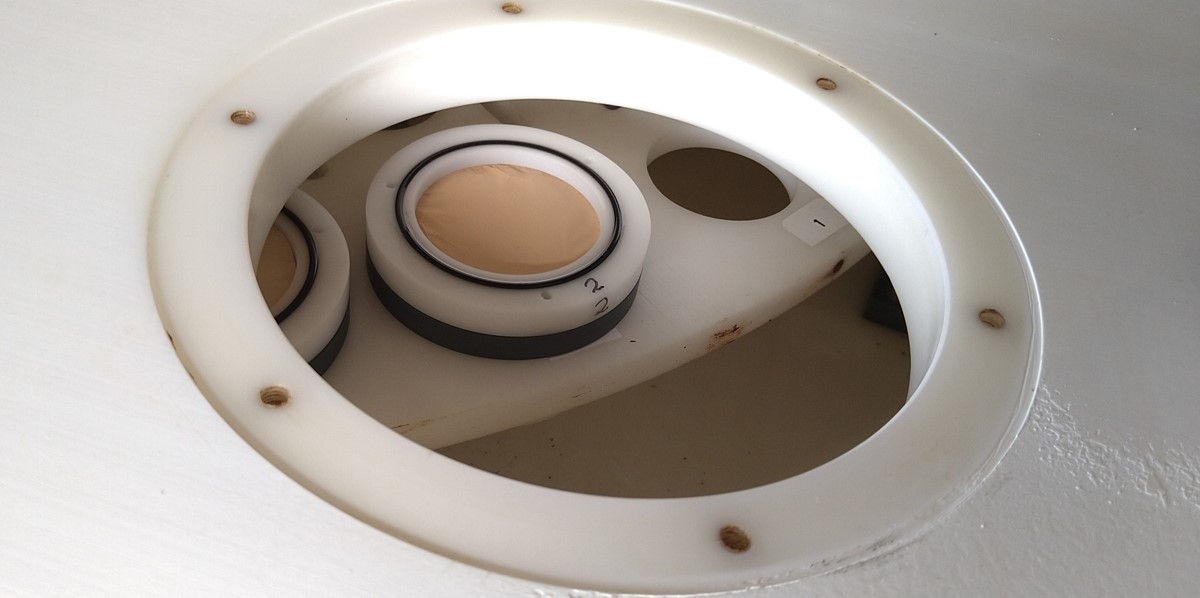
This is what we have been hoping for; nicely orange-coloured filters loaded with Saharan dust! The catch that has been collected since January this year is really excellent; virtually all filters contain some material, which we will process and analyse in the labs back home.
11 December – Teamwork
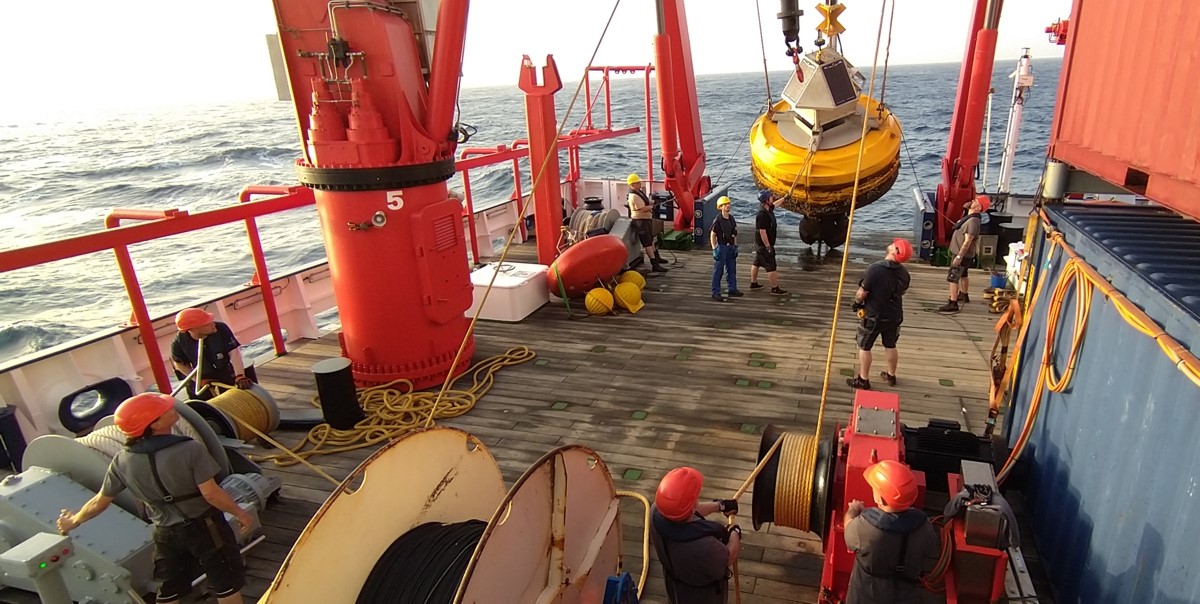
After more than three weeks at sea now, the NIOZ & MARUM technicians, bosun Enno and his men on deck, and master Björn and his officers both in the dinghy as well as on the bridge, are working as a team as if they never did anything else. Dust buoy Laura was recovered and re-deployed within 2½ hours, an excellent team effort!
10 December – Buoy in the dark
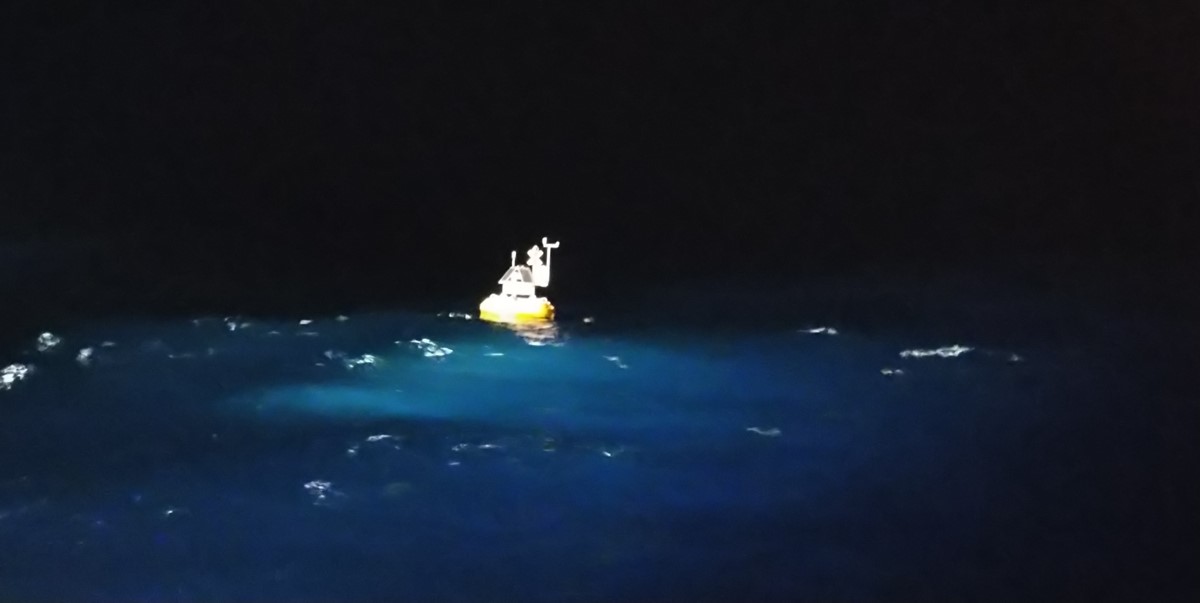
Both buoys Carmen and Laura are tethered to cables that are longer than the water depth they were deployed at. As a result, they have a small ‘circle of freedom’ to move about. Given that the Trades are mostly pushing the buoys towards the southeastern part of their circle, and since twice a day we get a mail with the whereabouts of the buoys, we know where to look. Yet, the easiest way to find them is to look in the dark when the flash light can be spotted from miles. We all enjoy the reunion with buoy Laura and look forward to recovering her first thing in the morning!
9 December – All hands on the bridge
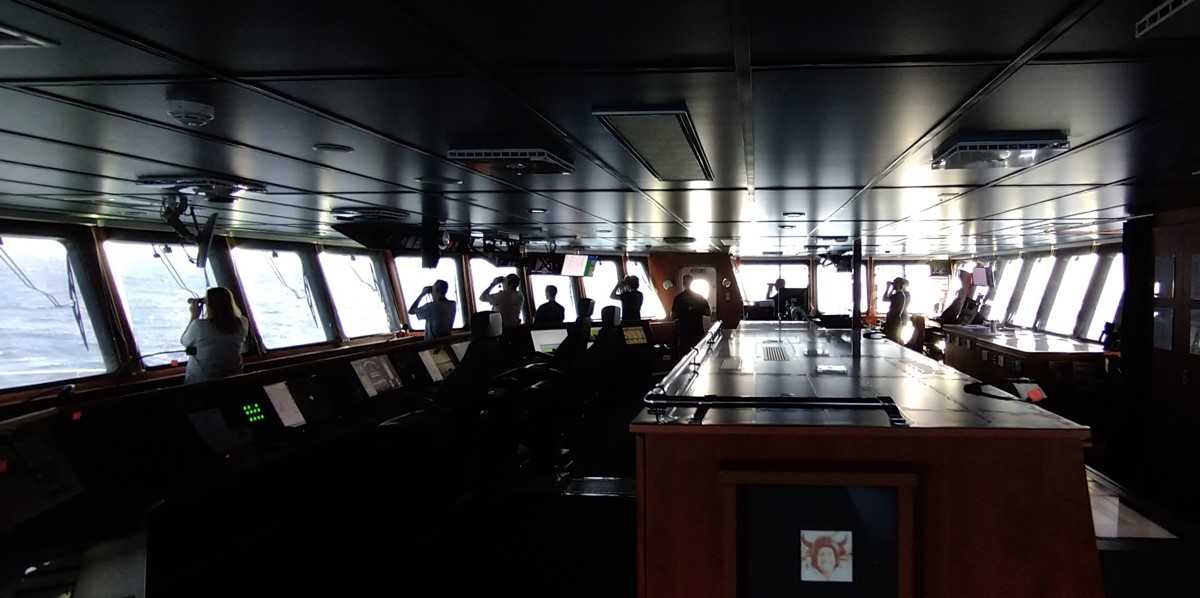
Today we are recovering the sediment-trap mooring that has been collecting material settling down the water column since we deployed her last January during RV Pelagia expedition 64PE482. This mooring consists of three sediment traps consisting of 39 bottles each, allowing a temporal crazy high resolution of two days. This means that we can potentially distinguish individual dust storms! The traps have been ‘hiding’ completely in the deep ocean (the ocean floor is more than 5,000m below the ship!) and after NIOZ technician Bob gave the acoustic command to release the anchor, the floats in the mooring are making their way up to the ocean’s surface. First we have to find her and to this end, there are many people on the bridge, hoping to be the first to spot the bright orange floats.
8 December – Drifting-trap results
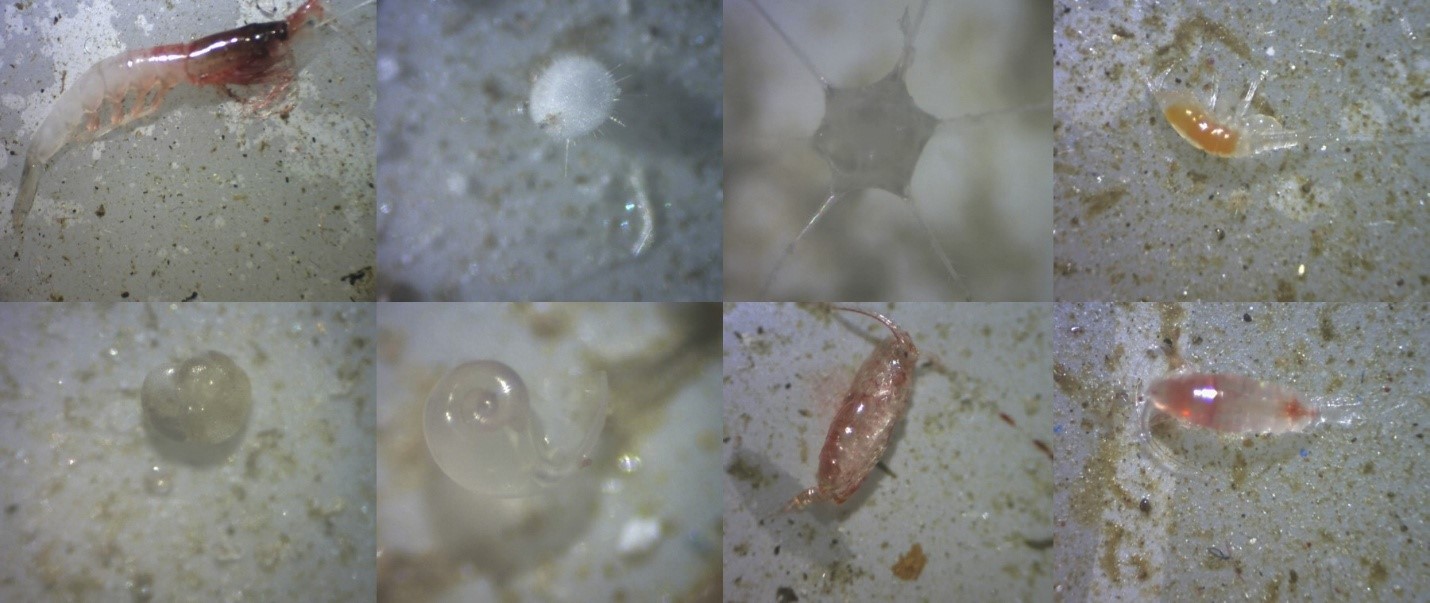
The drifting traps have been floating freely for about one day each in this time they have collected a lot of particles (SIPA is all about particles!) but also a lot of little creatures that are living in the ocean. Just out of curiosity we have looked at these creatures that we have filtered out of the water in the drifting traps. Some of these fascinating little creatures consist of jelly-ish material like jellyfish, some are made of organic silica and some of calcium carbonate. The top left shrimp was photographed at 10x magnification, all other images at 200x.
7 December – In dust, we….
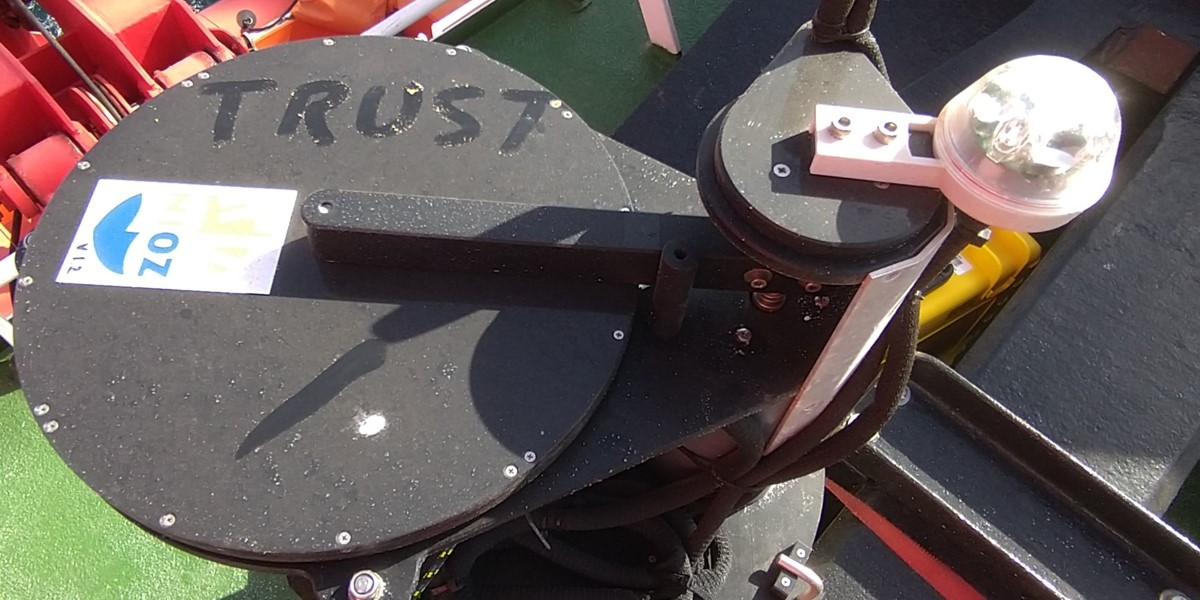
Just before reaching the Canary Islands (now that feels ages ago!) we had installed one of the prototypes rain collectors on one of the higher decks of RV Maria S. Merian. Now it was time to check if the rain measured by the rain sensor (the transparent dome on the top right) corresponds to the amount of water collected by the catcher under the black lid on the left.
Despite the few rain showers we had so far, it is clear that there is a coating of dust mixed with salt all over the collector.
6 December – Hooked
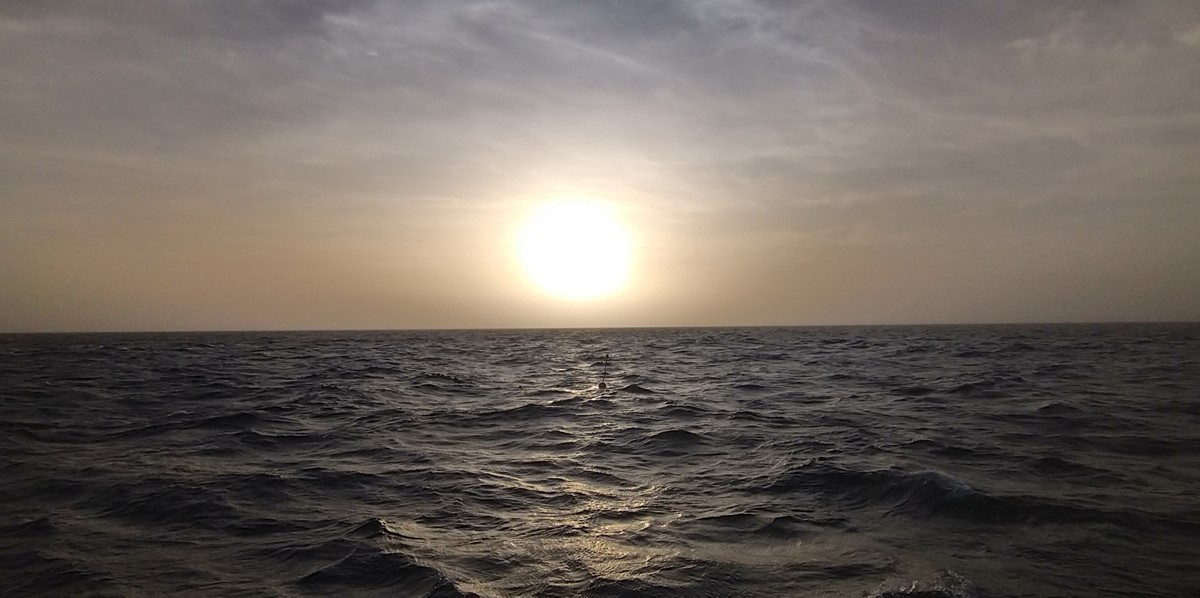
While leaving the Cape-Blanc area, heading south towards buoy Laura, we are still sailing through a cloud of Saharan dust, causing scenic dusty sunsets.
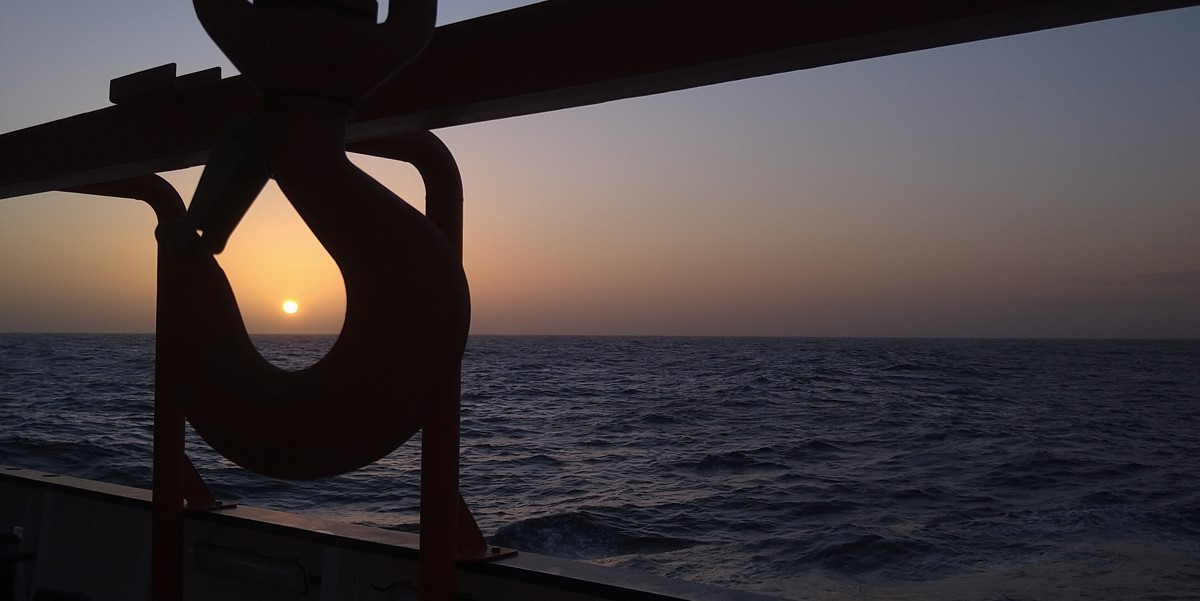
Somehow sun-ups seem less spectacular than sun-downs but the last few mornings we started with the recovery of the drifting traps and this morning the view out of the mess window treated us to both: a nice (dusty!) sun-up as well as a rare sight: the drifting traps floating by.
5 December – Cup deformations
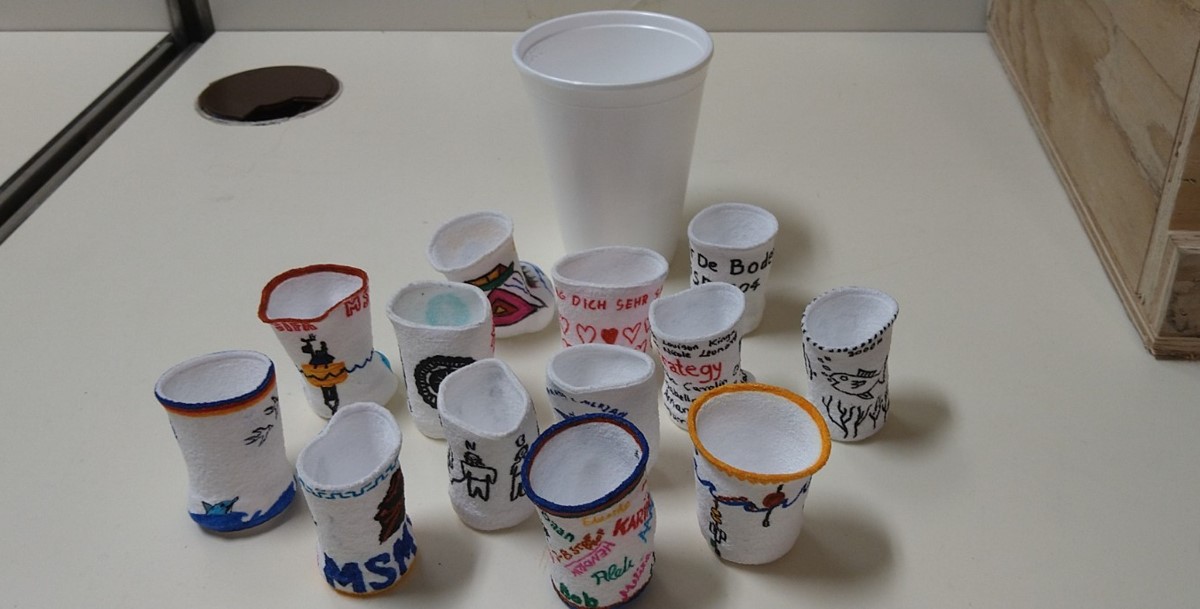
Per 10m water depth, the ambient pressure increases with 1bar. This is why we like to state that deep-sea research is much more difficult than space research; all our instruments need to be able to handle the enormous pressure differences. One way to visualize the pressure increase with depth is by sending styrofoam cups to the deep; all the air is pressed out of the foam and cups get small and rock hard. Since the pressure is in all directions, the cups maintain their shape and the decorations stay intact. These cups have been down to 2,500m = 250bar pressure. A pristine cup is shown for comparison.
4 December - SIPA: Sinking Particles (and their fate)
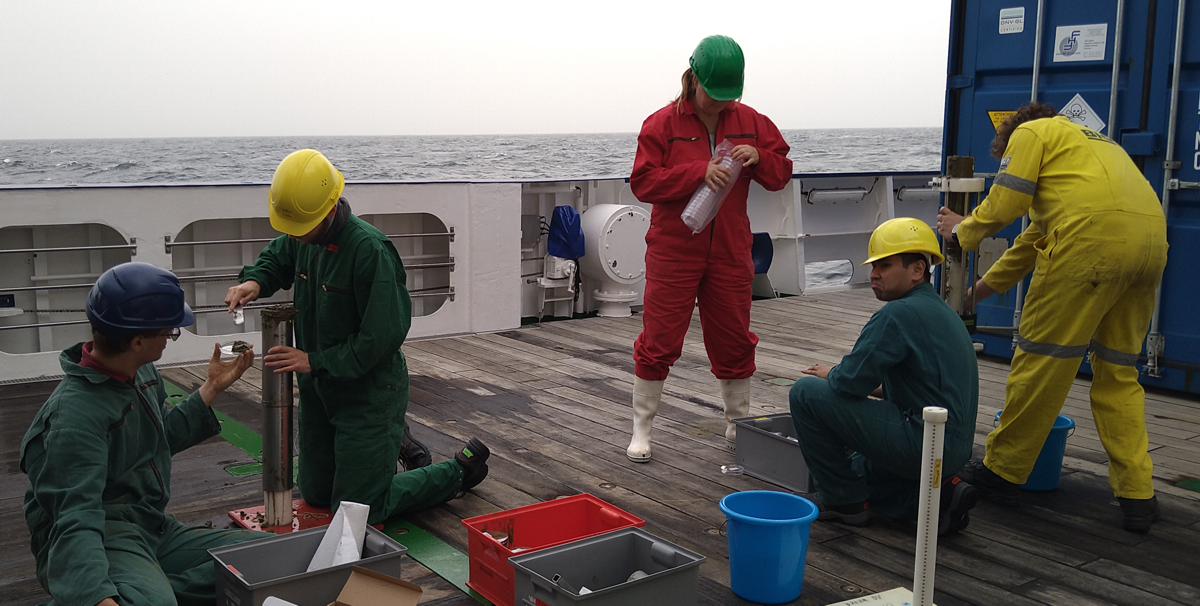
The ultimate stop for the particles that we are studying is the seafloor, now some 1,500m below the ship. To sample the sediment stack that is piling up on the sea floor, there are several devices. Since we are most interested in recent sedimentation processes, we focus on the sea-floor surface, which can best be sampled using a so-called multicorer (MUC). This multi corer allows simultaneous sampling of N=12 50-cm long cores at the same time, which are then distributed amongst the different scientific disciplines. Here you see various team members of SIPA in their colourful overalls, sampling in their specific ways that are needed for the specific analyses to be carried out later in the lab. These analyses vary from microplastics to particle-size analysis, various kinds of organic matter and biomarkers, dinoflagellates, foraminifera, diatoms, coccolithophores etc.
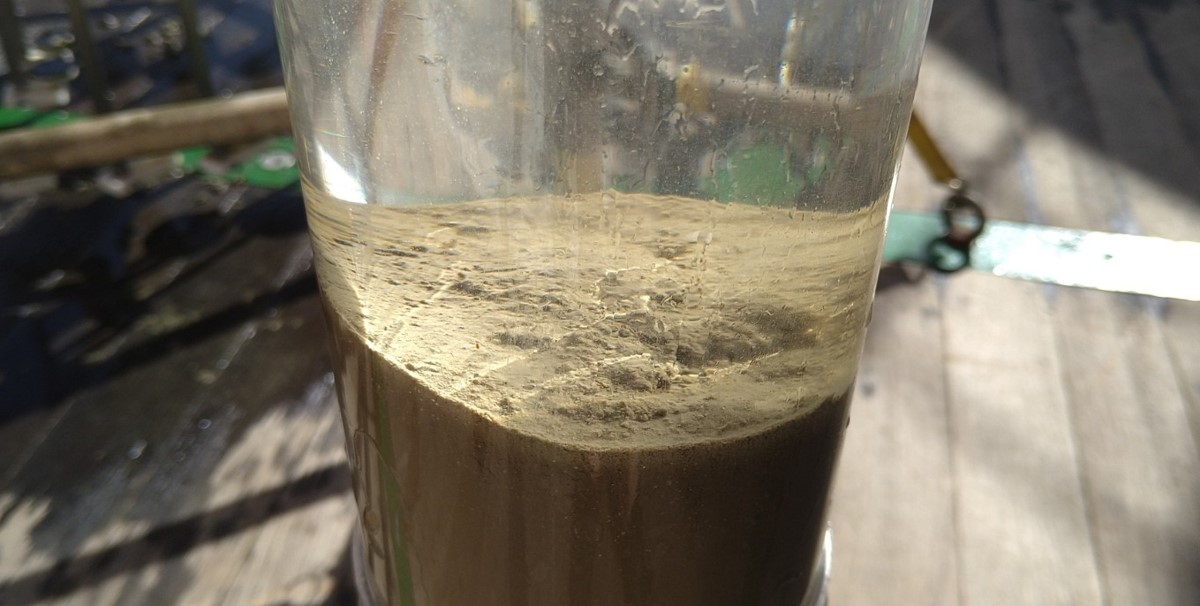
The big advantage of the MUC is that the sediment-water interface stays intact inside the tube; this is what the seafloor looks like (although it is pretty dark at 1,500m). The sediments are greenish thanks to the amounts of organic material and despite the deposition of orange dust.
3 December – dust forecasts
Nowadays there are excellent forecast models for mineral-dust emissions. One of those is Windy.com, which allows three-day forecasts. Four of these forecasts are combined in this clip to demonstrate that there indeed is a lot of dust in our study area off the Mauritanian coast at the moment. The buoy positions are indicated and the general ship’s track as well.
The animation nicely shows how there are several hotspots of dust emissions on the north-African continent. A few famous ones are in Chad, Algeria and on the west-African coast: in West-Sahara, Mauritania and Senegal. This model run also shows that by far not all dust travels westwards and it also clearly demonstrates how about 75% of the dust is deposited on the continent and only about 25% makes it out to sea (Shao et al., 2011 Aeolian Research 2, 181-204). Recent satellite studies estimate that every year about 182 million tons of dust are blown west from the northwest African continent (Yu et al., Remote Sensing of Environment 159, 232-249) across the Atlantic Ocean towards the Americas.
2 December - dust-fog
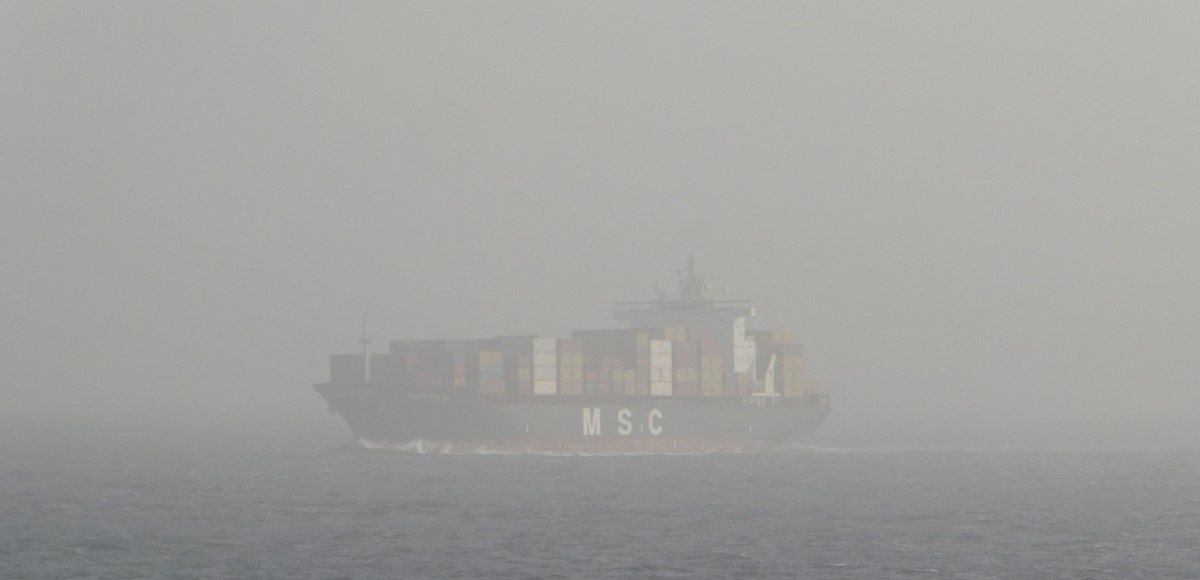
Next to all the marine-environmental consequences and potential of mineral dust, a very direct effect of all this material blowing through the atmosphere is a reduced visibility. Under normal conditions with clear skies, visibility at sea would be around 12-15nm (nautical miles, 1nm = 1.85km) but with this dust-fog it is reduced to less than ~3nm. Fortunately, RV Maria S. Merian's radar has little trouble 'seeing' through the fog.
1 December - dust all around
As expected, the eastern Trades that picked up yesterday are carrying large amounts of Saharan dust! There is so much dust around that visibility is drastically hampered. The setting sun cannot penetrate through the dense layer of dust hanging over the ocean, such that it has disappeared long before it sank into the ocean as it normally would have.
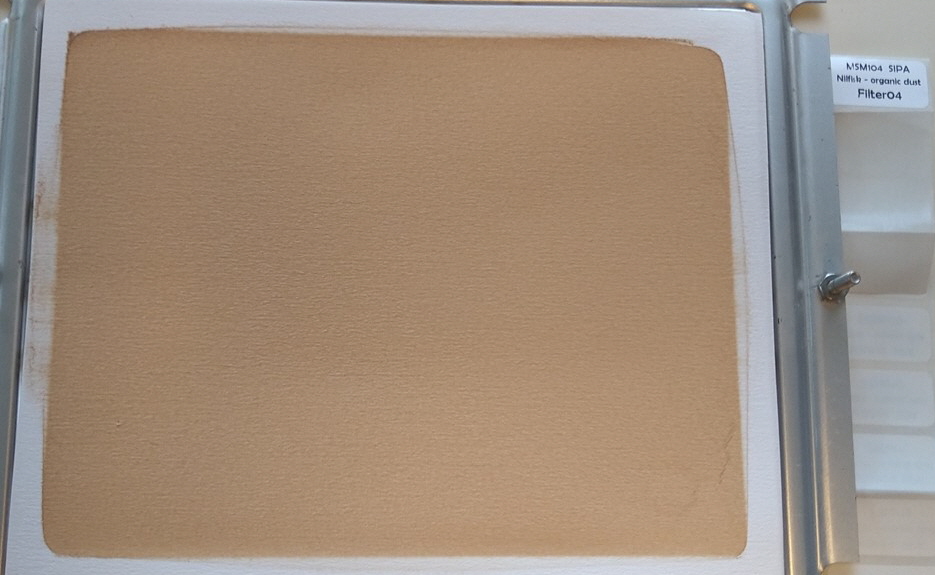
With the high-volume dust collectors on top of the bridge (see post of 20 November) large volumes of air are pumped through filters. The effect is clear and the colour matches that of the atmosphere: Saharan dust!
30 November - no dust without wind
The wind has picked quite nicely, which means that chances on Saharan dust are increasing. However, the strong winds (up to 19m/s ~Bft 8) also whip up the waves, as you can see in this clip.
29 November – how’s the weather?
Every day at exactly 10.30 UTC all over the Atlantic Ocean weather balloons are launched from ships to get an idea about the meteorological conditions in the atmosphere. These daily measurements are used by all kinds of met-offices in Europe and the data flow into computer models to make the weather predictions more accurate. The DWD – Deutsche Wetter Dienst installed a dedicated meteo-container on the Maria S. Merian to participate in this measuring program and the ship’s electronic officers launch a balloon every day.
Update in progress after removal from NIOZ pages, 1 March 2026

 +31 222 369 405 (NIOZ)
  jbstuut@nioz.nl